UNL Microbiology Research Symposium
Registration is EXTENDED through December 2, 2025.
The Microbiology Achievement through Research and Valuable Experiential Learning (MARVEL) started in 2021 with the goal of supporting the academic success and building community for undergraduate students in the Microbiology Program at UNL. The MARVEL Program organizes two events annually including a workshop and the UNL Microbiology Research Symposium each fall semester.
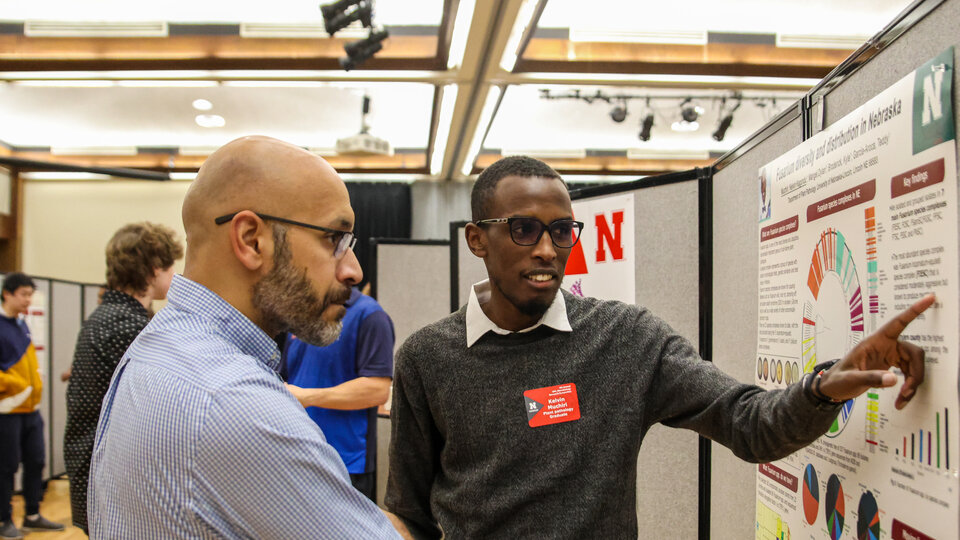
The 5th Annual UNL Microbiology Research Symposium is scheduled for Friday, December 5th, 2025 in the Nebraska Union on UNL City Campus. The keynote speakers will begin at 3pm in the Swanson Auditorium followed by undergraduate, graduate and post doc poster presentations in the Centennial Ballroom at 4pm until 6pm. Light refreshments will be furnished. Register to attend.
This year's keynote speakers are:
Dr. Gemma Reguera, Professor of Microbiology, Genetics & Immunology at Michigan State University.
Title: “Reimagining microbial interactions for a sustainable future”
Through their control of the biogeochemical cycling of carbon, nitrogen and other elements, microbes impact planetary processes at a global scale and offer solutions for advancing social and economic prosperity. Our research reimagines microbial interactions with metals and minerals to address challenges in resource recovery, energy production, and environmental resilience. By integrating microbiology, materials science, and biotechnology, we uncover mechanisms of mineralization and electron transfer that enable circular use of natural resources. This talk will highlight microbial physiologies and engineered systems that illustrate how fundamental discoveries can be translated into scalable solutions for environmental sustainability and economic growth.
Dr. Lindsey Crawford, Assistant Professor in the Department of Biochemistry at the University of Nebraska-Lincoln.
Title: “Viral Control of Stem Cell Fate: How a Chronic Human Herpesvirus Regulates Pathogenesis, Immunity, and Hematopoiesis”
Hematopoiesis is a highly regulated and complex process where hematopoietic stem cells (HSCs) differentiate into mature, functional immune cells. This process is essential for a functioning immune system, but the main factors underlying HSC fate and function are still unclear. Chronic viral infection (including the human herpesviruses CMV and HHV-6) change HSCs both through direct and indirect ways, which can lead to significant health complications including immunosuppression and transplant complications. The viral lifecycle of CMV and HHV-6, both highly human-specific viruses, is intrinsically integrated with stem cell function. In turn, regulation of hematopoiesis is key to the viral lifecycle and to maintenance of chronic, life-long infection. Several CMV multigene families cooperatively and precisely regulate cellular pathways, especially those with key roles in essential functions in HSCs (e.g., proliferation, differentiation, control of apoptosis, quiescence, and immune responses). Here we address the role of the understudied CMV RL11 gene region in controlling essential cellular functions including proliferation and differentiation. Additionally, we previously demonstrated how viral infection (by a wide variety of different viruses) directly controls HSCs (and their downstream differentiation). Understanding the role of the CMV RL11 genes and by using comparative analysis between viruses allows us to develop a better understanding of normal stem cell function.
Poster registration is EXTENDED through December 2, 2025.
We Are Gold Certified!
Our Commitment to Sustainability
We are proud to announce that the upcoming 5th Annual UNL Microbiology Research Symposium is a Certified Sustainable UNL Event at the Gold level! We are showing our commitment to sustainability by prioritizing sustainability in the event’s communication and waste efforts. Please join us in making a difference and promoting sustainability by bringing a reusable water bottle or coffee cup to reduce plastic and paper waste.
If you need any accommodations to be able to participate in the event fully, please let us know via email (microbiology@unl.edu) or at the time of the Symposium.